
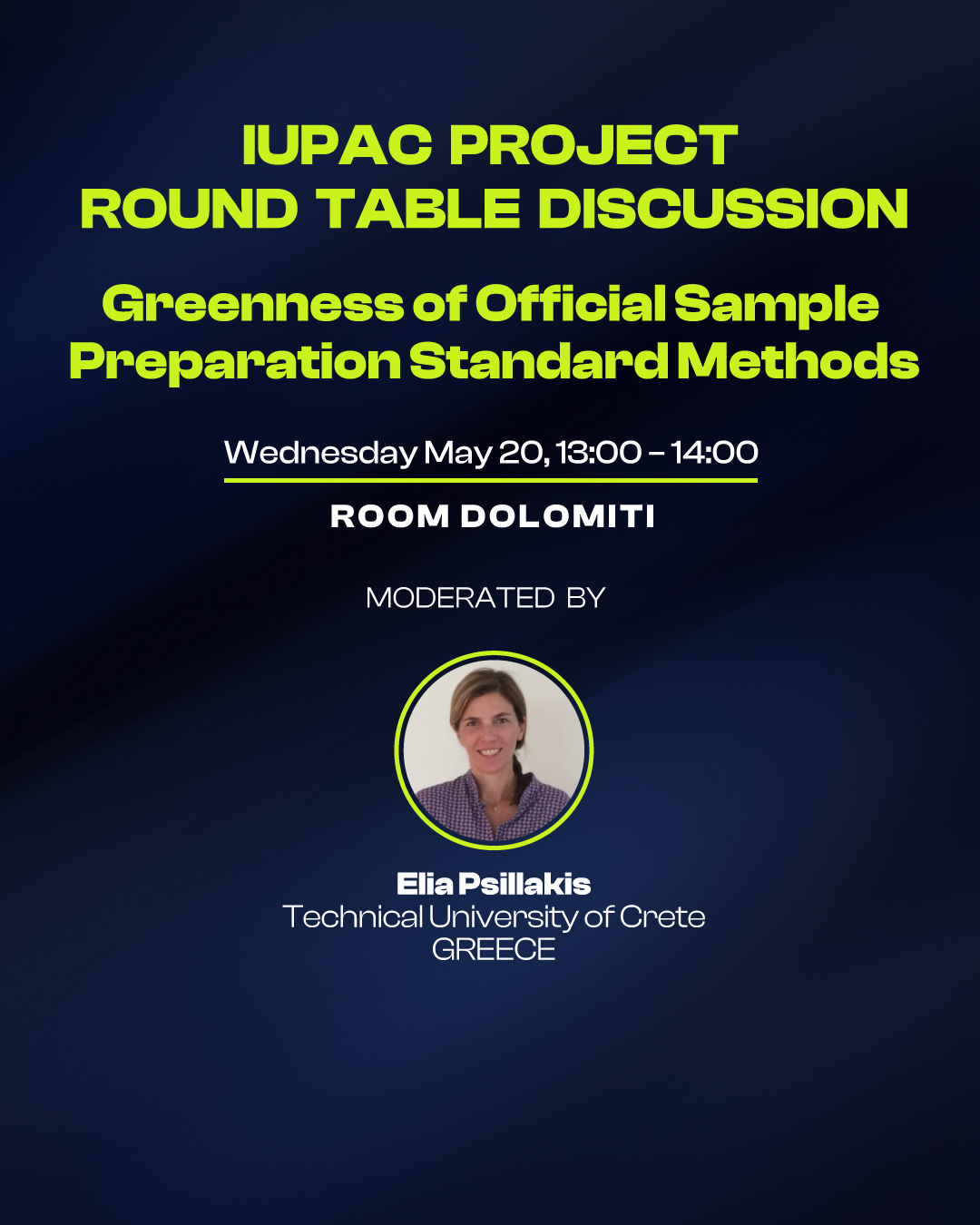
IUPAC Project Round Table Discussion: Greenness of official sample preparation methods

Panelist: Prof. Stig Pedersen-Bjergaard (University of Oslo, Norway), Prof. František Švec (Charles University, Czech Republic), Dr. Björn Erxleben (Shimadzu Europa, Germany), Dr. Frank Michel (Merck, Germany), Dr. Massimo Santoro (Markes International, UK).
 
Analytical laboratories worldwide rely on official standard methods to ensure accuracy, reproducibility, and regulatory compliance. Yet, the environmental, health and safety impacts of these methods has remained largely unevaluated.
 
Under the umbrella of an IUPAC project (https://iupac.org/project/2021-015-2-500/), an international team has conducted the first large-scale, systematic greenness assessment of official standard methods used in environmental, food, trace element, and pharmaceutical analysis. Using the AGREEprep metric (developed within the same project), the results are sobering: the majority of evaluated methods scored below 0.2 on a 0-to-1 greenness scale. This outcome translates that routine laboratories find themselves locked into using outdated, harmful and resource-intensive methods, not by choice, but because compliance and accreditation leave them no alternative.
This roundtable brings together a distinguished panel bridging academia and industry to discuss the outcomes of this unique IUPAC initiative and, more importantly, the means to change. Following the dynamic panel discussion, a Q&A session will provide an open forum for participants to interact directly with the experts, share real-world challenges, and explore practical solutions. Join us for a forward-looking discussion that moves beyond general concepts to actionable strategies for greening the rulebook of analytical chemistry.

Round Table: Capillary LC Separations – On the Horizon and Beyond

This discussion session will bring together instrument manufacturers, end users, column developers, and thought leaders to have an open, candid discussion about why capillary LC and nanoLC haven’t experienced wider adoption. Through guided discussion and informal exchange, participants will examine whether the primary challenges are technical—such as robustness, extra-column effects, and column reliability—or whether usability, cost, organizational risk tolerance, and cultural inertia play a larger role.

Topics will include unresolved instrumentation and column hardware challenges, manufacturing and quality control limitations, real versus perceived performance concerns, and the ongoing tension between innovation and the practical needs of high-throughput and QC laboratories.

A second focus of the workshop will explore value propositions and future pathways for capillary LC adoption. Participants will critically assess whether green chemistry arguments meaningfully resonate with decision-makers, where capillary LC delivers truly unique advantages. The discussion will extend to workforce readiness, automation, regulatory expectations, and what level of reliability and standardization would be required for routine QC deployment. The session will conclude by exploring a realistic roadmap for the next decade—identifying the technological breakthroughs, data, standards, and leadership needed for capillary LC to transition from a powerful emerging tool into a trusted, mainstream analytical platform.